Selling an Inherited Home in Pasadena, Deer Park or La Porte, Texas: What Families Need to Know — Including Transitions to Nursing Homes or Assisted LivingInheriting a home can feel

Dated: August 15 2025
Views: 83
Revocable Living Trust
You (the grantor) keep complete control over the assets during your lifetime.
You can change, amend, or completely revoke the trust at any time.
Ideal for individuals seeking flexibility in case circumstances change.
Irrevocable Trust
Once set up, you generally cannot change or revoke it without court approval or beneficiary consent.
You give up ownership and control over the assets placed inside.
Both avoid probate for assets appropriately titled in the trust, which can speed up estate settlement and keep it private.
Revocable Living Trust
No asset protection from creditors during your lifetime.
Assets are still considered yours for tax purposes, so no estate tax reduction.
Irrevocable Trust
Offers asset protection—creditors generally can’t reach the assets.
Can remove assets from your taxable estate, potentially lowering estate taxes.
Useful for Medicaid planning or protecting assets for future generations.
Revocable Living Trust
Uses your Social Security Number; income is reported on your tax return.
Irrevocable Trust
Becomes a separate tax entity with its tax ID number (unless set up as a grantor trust).
May have higher trust tax rates if income is retained inside the trust.
Revocable Living Trust
Avoiding probate.
Keeping control during your lifetime.
Simplifying asset management if you become incapacitated.
Irrevocable Trust
Protecting assets from lawsuits or creditors.
Estate tax reduction.
Long-term care/Medicaid planning.
Charitable giving strategies.
✅ In short:
Choose a revocable living trust if you want flexibility, control, and to avoid probate.
Choose an irrevocable trust if you want asset protection, tax advantages, or to meet Medicaid eligibility rules—and you’re okay giving up control.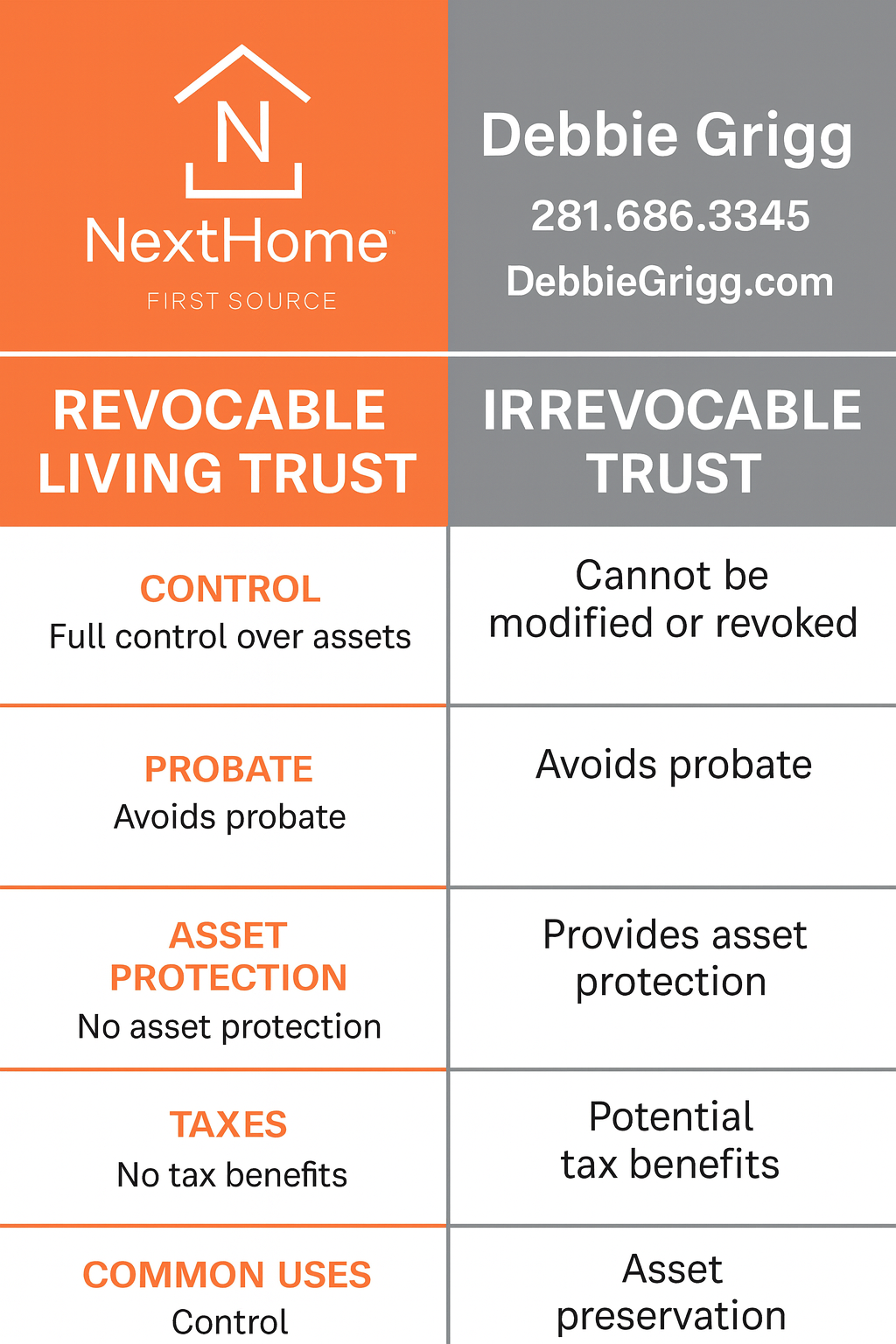

Debbie Grigg: The Realtor Who Turns Houses into Homes If you were to meet Debbie Grigg for the first time, you’d immediately sense her passion—not just for real estate, but for people. With a ....
Selling an Inherited Home in Pasadena, Deer Park or La Porte, Texas: What Families Need to Know — Including Transitions to Nursing Homes or Assisted LivingInheriting a home can feel
If you've ever driven past a cluster of balloons and an "OPEN HOUSE" sign on a Saturday afternoon, you've probably wondered the same thing most sellers ask me: **do these things actually work?** And
Selling your home is one of the biggest financial decisions you will ever make. With so many online websites and “For Sale By Owner” options available today, many homeowners ask the same
🏡 TEXAS PROPERTY OWNERS — DON’T MISS YOUR PROPERTY TAX PROTEST DEADLINE! ⏰If your property value jumped this year, NOW is the time to review your appraisal and file a protest. In
Should you require assistance in navigating our website or searching for real estate, please contact our offices at 281-686-3345.
Texas Real Estate Commission Consumer Protection Notice
Texas Real Estate Commission Information About Brokerage Services (IABS)

Each office is independently owned and operated.
The accuracy of all information, regardless of source, including but not limited to open house information, square footages and lot sizes, is deemed reliable but not guaranteed and should be personally verified through personal inspection by and/or with the appropriate professionals. The data contained herein is copyrighted by Houston Realtors Information Service, Inc. and is protected by all applicable copyright laws. Any unauthorized dissemination of this information is in violation of copyright laws and is strictly prohibited. Copyright 2026 Houston Association of REALTORS, Inc. All rights reserved. Last Update: September 23, 2026 6:37 PM UTC The information being provided by Houston Association of REALTORS, Inc. is for the consumer's personal, non-commercial use and may not be used for any purpose other than to identify prospective properties consumers may be interested in purchasing. Any information relating to real estate for sale referenced on this web site comes from the Internet Data Exchange (IDX) program of the Houston Association of REALTORS, Inc. This web site may reference real estate listing(s) held by a brokerage firm other
than the broker and/or agent who owns this web site.
The information being provided by Houston Association of REALTORS, Inc. is for the consumer's personal, non-commercial use and may not be used for any purpose other than to identify prospective properties consumers may be interested in purchasing. Any information relating to real estate for sale referenced on this web site comes from the Internet Data Exchange (IDX) program of the Houston Association of REALTORS, Inc. This web site may reference real estate listing(s) held by a brokerage firm other
than the broker and/or agent who owns this web site.
